TECTONICS BLOG
Rev. 01/03/2026
TECTONICS BLOG
Rev. 01/03/2026
TECTONICS BLOG
Rev. 01/03/2026
|
Click on an image to enlarge it
Figure
2.
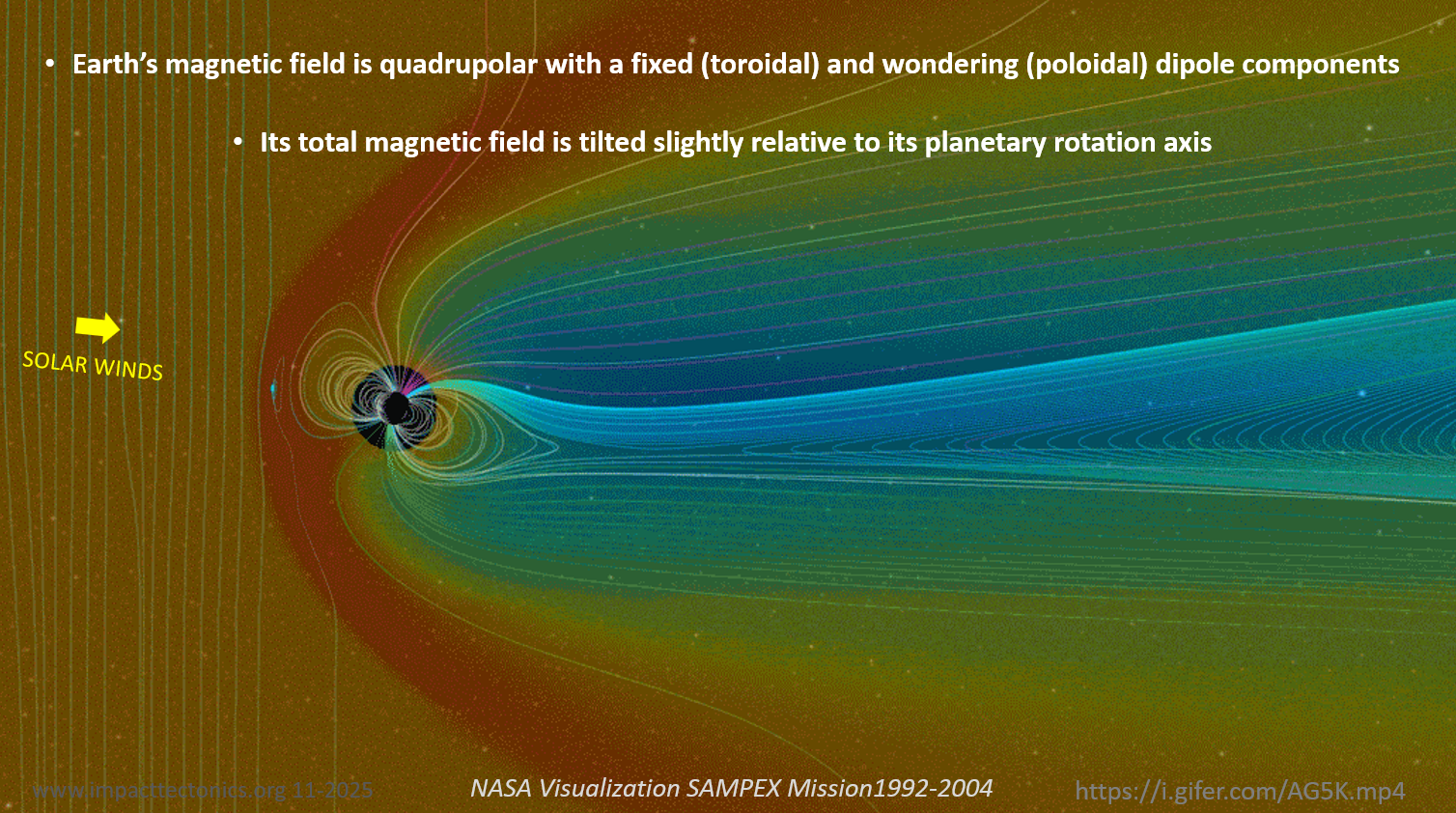
The physical nature of Earth's external
magnetic field is captured in this NASA video gained from their
1992-2004 SAMPEX mission. The radiation belts are mapped using false
colors to highlight relative densities of trapped electromagnetic
particles from the solar winds.
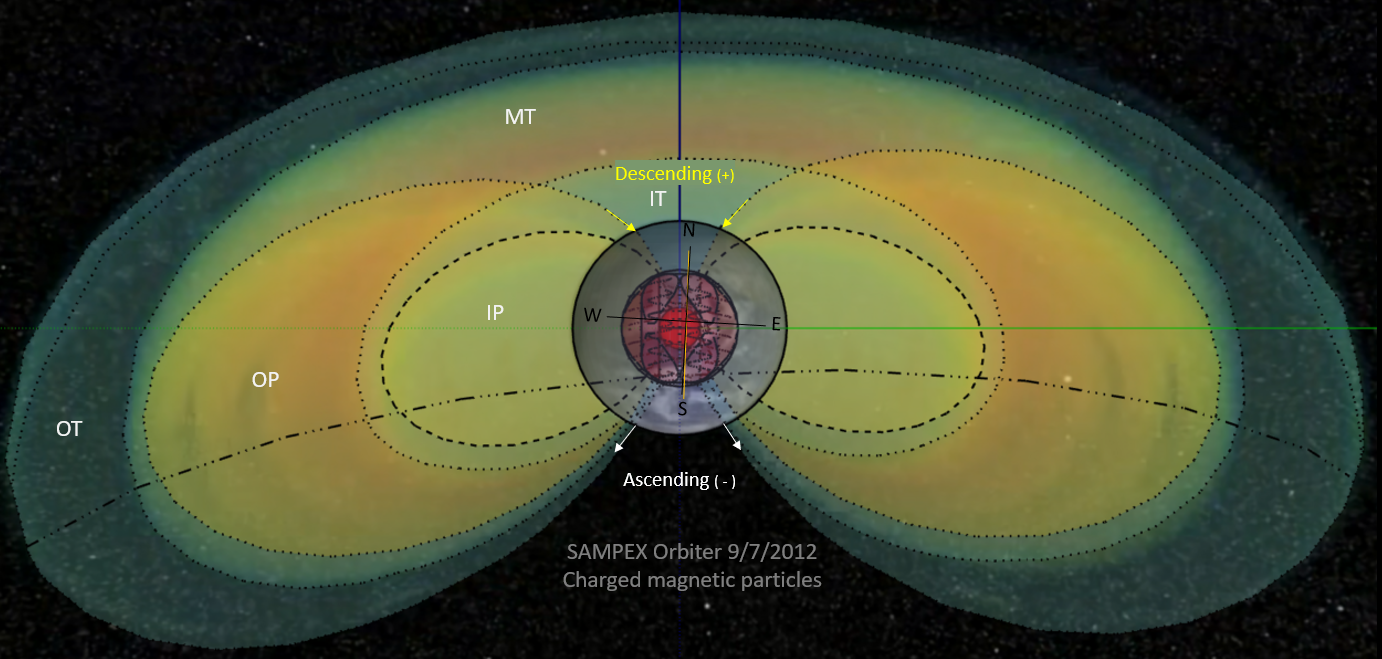
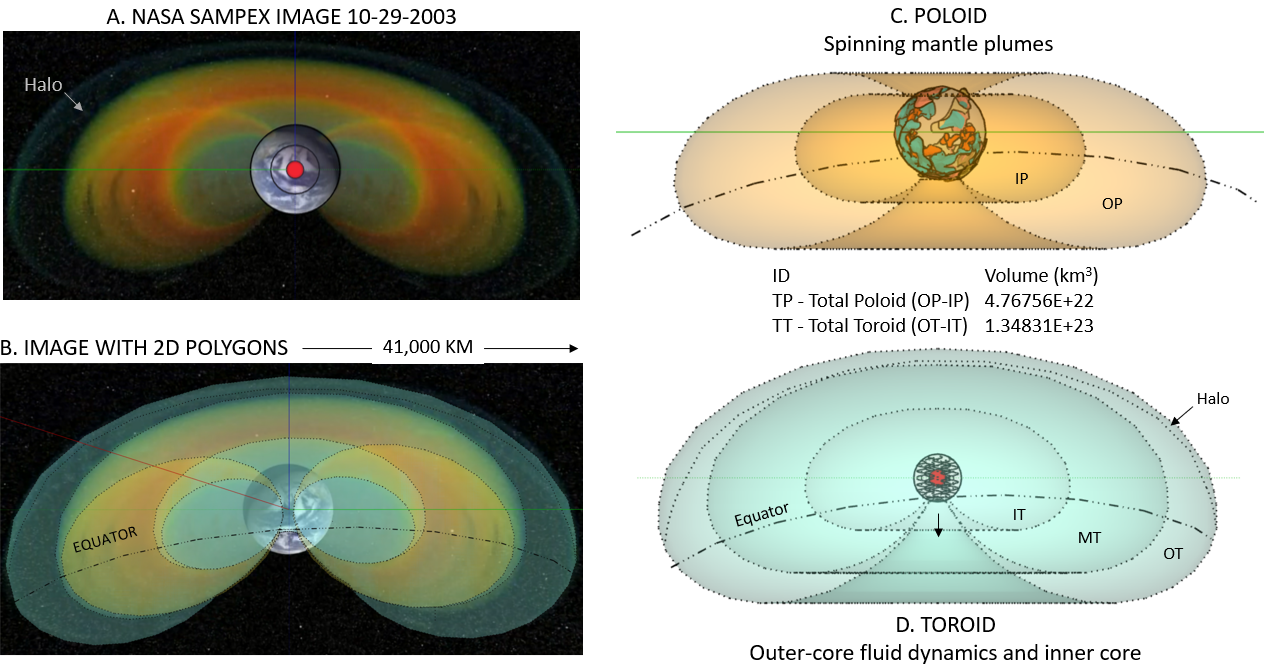
Click on the image to watch the video. Figure 4. The external
magnetic-field expression includes inner and outer (Van Allen) radiation
belts. The inner belt (poloid moment) is a pulsating, asymmetric loop
surrounded by the steady outer belt (toroid moment). A SAMPEX image from
09/07/2012 was used as the basis to conduct a comparative 2D area and 3D
volumetric analysis of the respective geomagnetic field components using
the SketchUp Pro 2024 architectural computer-aided drafting program.
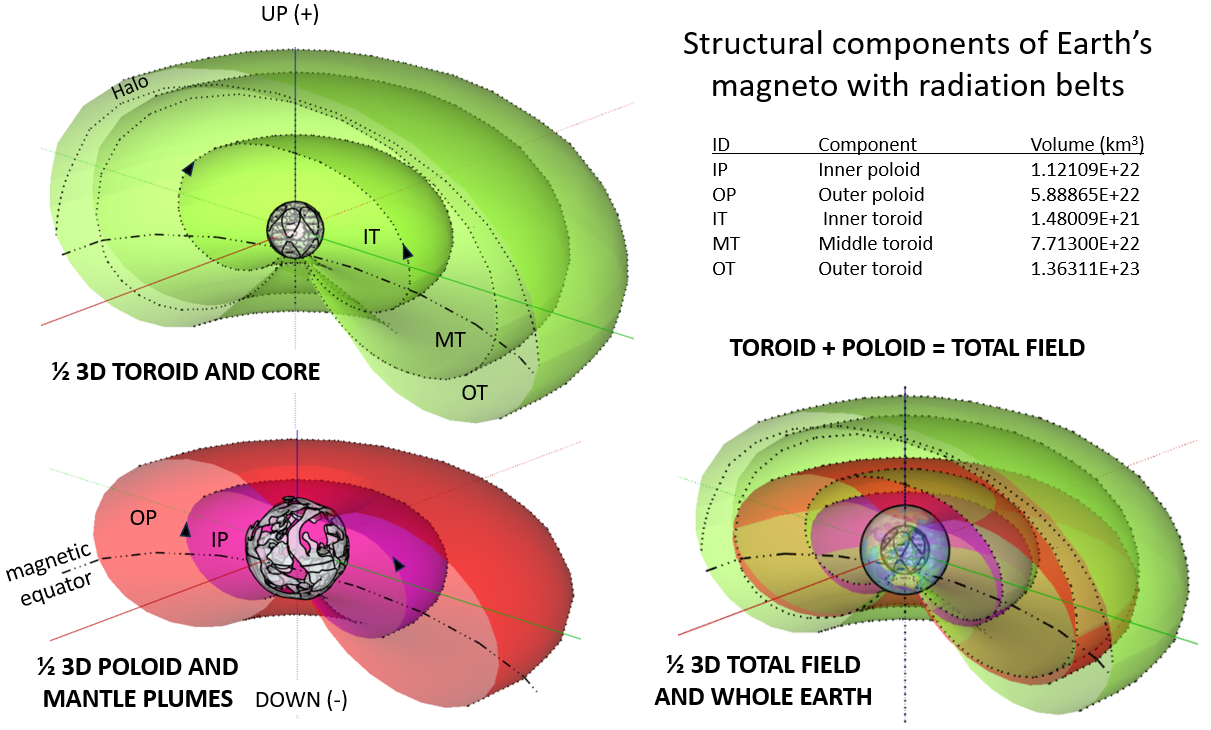
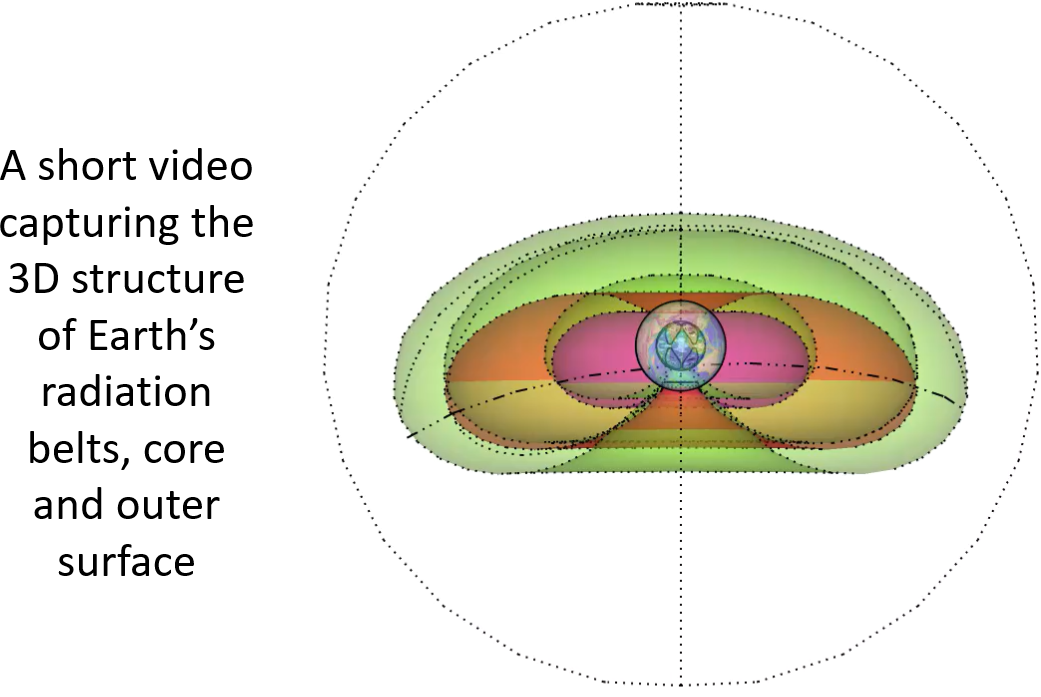
Figure 9.
Click on the image to open a short video
highlighting the 3D nature of Earth's electromagnetic field.
|
Gregory Charles Herman,
PhD
Flemington, New Jersey, USA
The Structure of Earth's Geodynamo
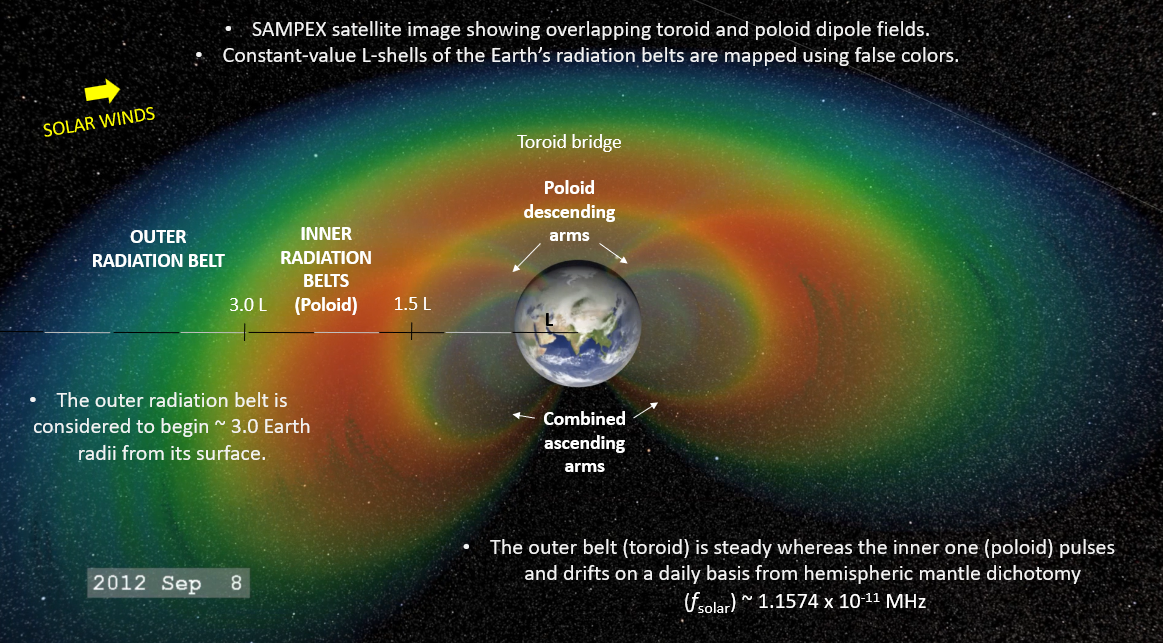
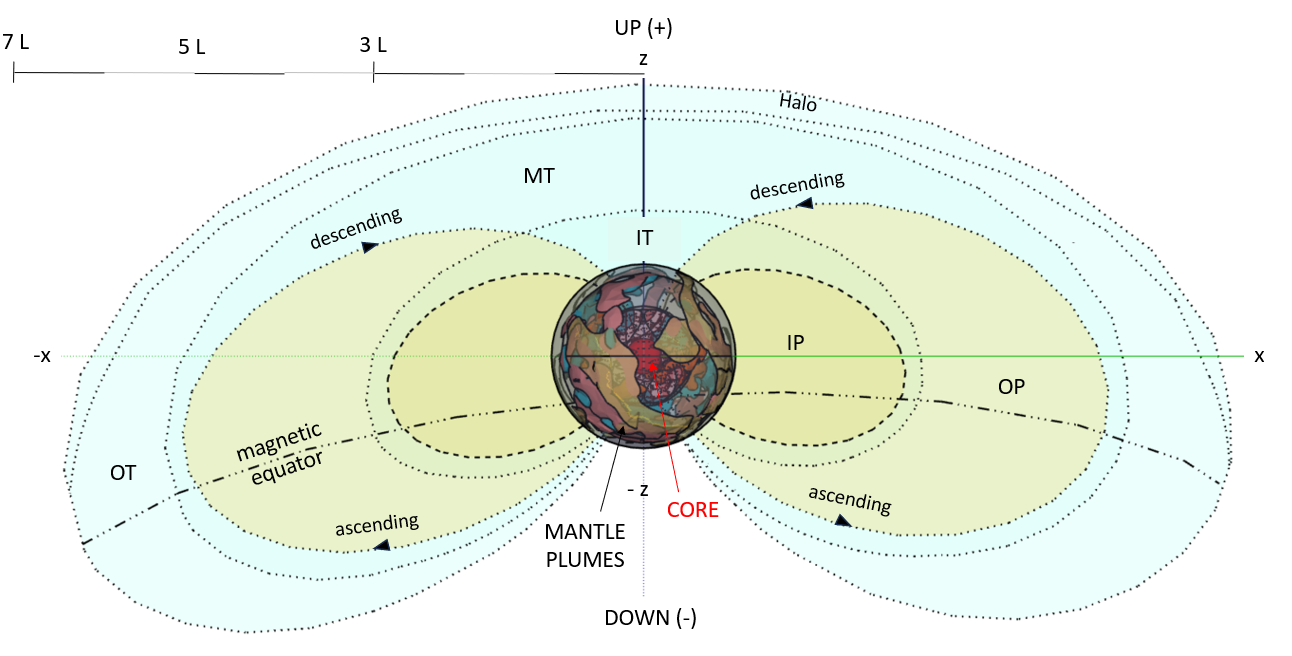
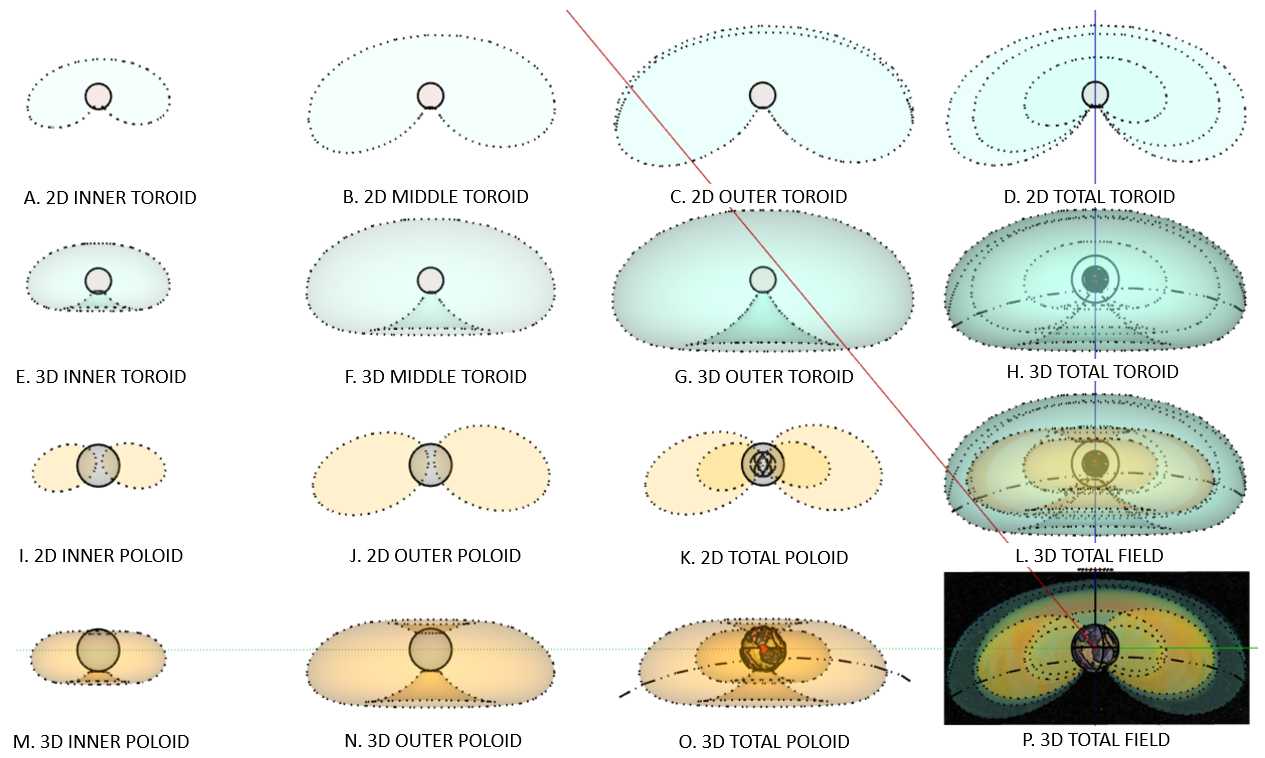
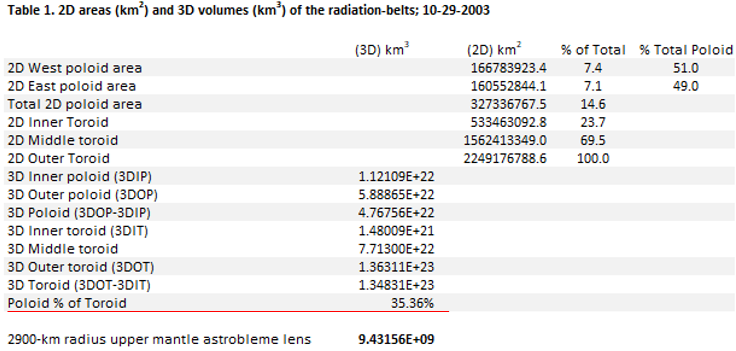
The U.S. National Space and Aeronautical Administration (NASA) releases short videos that characterize the geospatial and temporal nature of Earth's external radiation belts gained from their 2012-2020 SAMPEX mission (figs. 1 and 2). The inner radiation belt pulsates on a daily basis and they continuously fluctuate in extent depending upon the intensity of the solar winds and Earth's inductive response (fig. 2). A snapshot of the SAMPEX-sampled radiation belts from 09/07/2012 was used to quantify their 2D and 3D components based on their false-color representation that highlights regions in space surrounding Earth where various atomic particles in the Solar winds get trapped and temporarily held by the radiation belts. My interpretation of the SAMPEX data into the two, main, poloid and toroid dipole components is summarized in figures 4 to 9. As summarized in figure 6, the toroid moment envelopes the smaller poloid and is estimated to be about three times as large. Figures 8 and 9 show how the respective total-field components overlap.
The inner and outer radiation belts highlight two main components of Earth's
geomagnetic field including the stable, larger toroid moment and the wandering,
smaller poloid moment. The outer radiation belt is correlated with the toroid
moment as its larger, steadier, and appears to be influenced by the smaller and variable poloid moment where the two field components overlap. The inner
radiation belt is correlated with the poloid moment generated by rotating
electrically-charged mantle plumes rising off the outer core about the planetary
spin axis, because rotating volumes of charged Earth media about a central axis
will produce various magnetic moments. The moment intensity and form relate to
its size (radius r), how fast it rotates (angular velocity
Equation 3 is typically derived using the definition of the magnetic dipole moment for a current distribution, which involves treating the rotating charge as a volume current density.
Equation 6. urotms=Vmantle=Vrmax–Vrmin, or,
Equation 9. urotms=Qmsꙍ(r5max- r5min)/(rmax3- rmin3)/5
The only unknown variable in equation 9 is the inherent electrical charge Q.
Earth's outer core structure and the toroid dipole moment
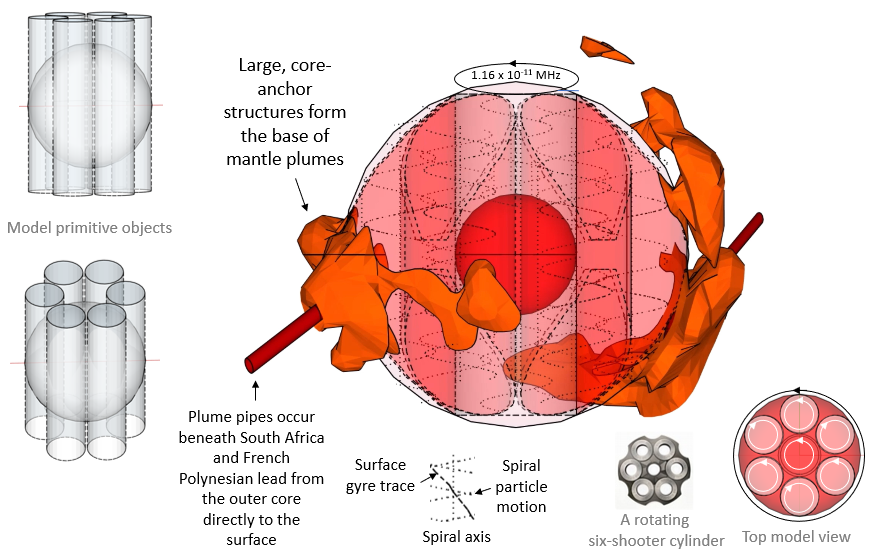
The toroid dipole moment of the total field is probably generated by the alignment of electron spin within circulating, ferrous fluids in Earth's outer-core shell. According to de Wijs and others (1998), fluids move under the Coriolis effect resulting in spinning, inner and outer cylindrical columns with radii comparable to the inner core (fig. 10). The outer-core columns are thought to occur in a hexagonal, closely-packed (h.c.p.) crystal form with adjacent columns spinning in opposing directions outward from the equator. The intersection of the outside columns form tear-drop-shaped surface gyres at the mantle base where two core-anchor structures in opposing hemispheres form the roots of overlying mantle plumes that are electromagnetically wired into the outer core (fig. 10) .
Earth's mantle-plume hemispheric heterogeneity and the poloid dipole moment
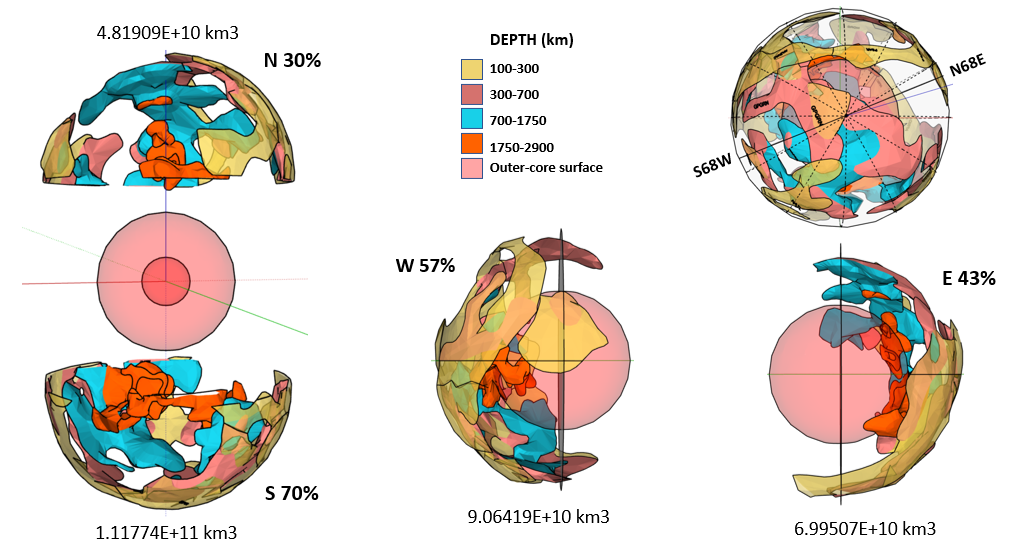
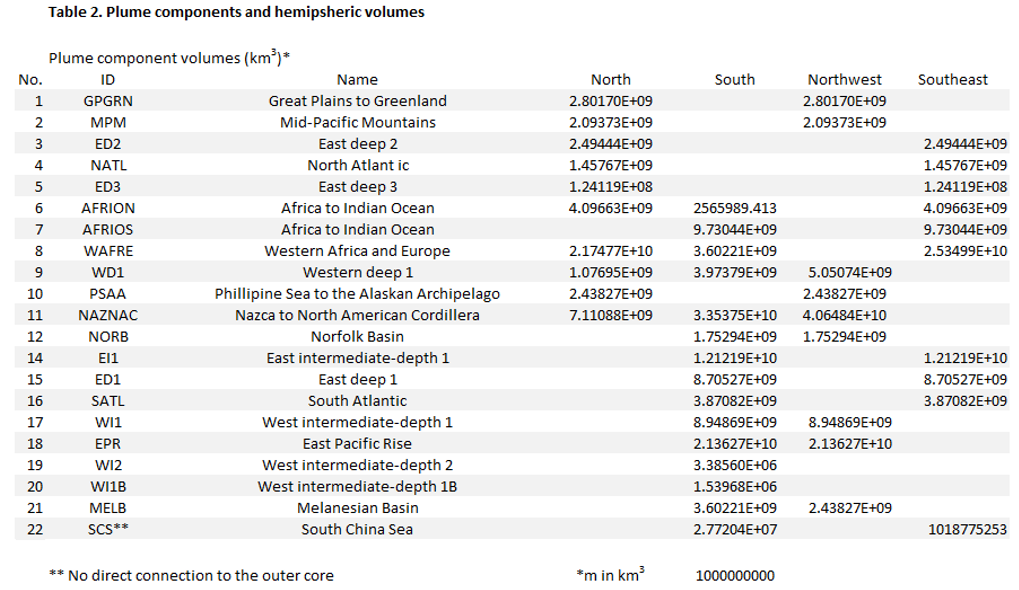
A 3D computer model was used to quantify the volume of Earth’s external radiation belts and electromagnetically charged body structures that generate the toroid and poloid dipoles of its quadrupole geomagnetic field. 3D objects representing the inner and outer radiation belts were modeled in 3D and their volumes computed using a 09/07/2012 snapshot of the NASA SAMPEX satellite data with the SketchUp Pro 2024 computer-aided drafting (CAD) system. The smaller, more variable and weaker inner belt was computed to be about 35% the volume of the outer belt, pulsates on a daily basis, and is correlated to the Earth's poloid dipole moment generated by rotating electrically-charged mantle-plume about a central axis. A 3D CAD model of the mantle plumes was built using the 35% slowest values in Moulik and Ekström (2014) S362ANI+M global shear-wave velocity model. The toroid is the stronger, steadier dipole moment that's spatially fixed to the planetary spin axis and generated in the outer core where six, cylindrical fluid columns spiral upward and downward from the equator and form tilted surface gyres at the outer-core and mantle interface. The toroid moment therefore likely arises from aligned electron spin in fluid media. The mantle plumes that generate the poloid dipole are anchored to the outer core by two, basal structures situated in opposing, longitudinal hemispheres. The overlying, evolving plumes weave upward through the mantle and into the crust beneath magmatically active oceanic spreading centers and crustal hot spots. Daily pulsations of the poloid results from plumes having longitudinal heterogeneity (West:East = 55:45%). Earth’s total field is south negative, and the total field is skewed southward because ~70% of the plume bulk resides in the southern hemisphere. Poloid fluxes probably result when km-scaled bolide impacts suddenly produce large igneous provinces that alter hemispheric volumes of charged and connected mantle media. Large northern impacts could thereby potentially induce temporary, poloid-moment polarity reversals that could, in turn induce total-field polarity fluxes. The distribution of protons and electrons in the external radiation belts reflects intensity variations in the total field from having overlapping and interfering dipole moments. The dipole moments resulting from rotating spherical, charged body components about a rotation axis are expressed algebraically.
References
de Wijs, G.A, Kresse, G., Voc., L., Dobson, D., Alfe, D., Gillan, M.J., and Price, G.D., 1998, The viscosity of liquid iron at the physical conditions of the Earth’s core, Nature, vol. 392, p. 305-307.
Herndon, J. M., 2022, Origin of Earth’s Magnetic Field, its Nature and Behavior, Geophysical Consequences, and Danger to Humanity: A Logical Progression of Discoveries Review. European Journal of Applied Sciences, vol. 10, no. 6, p. 529-562.
Herman, G.C., 2022, Punctuated Tectonic Equilibrium, www.impacttectonics.org. 202 p. Amazon Books, https://www.amazon.com/dp/B0BHSZDXDS?ref_=pe_3052080_397514860.
Moulik, P. & Ekström, G., 2014. An anisotropic shear velocity model of the Earth's mantle using normal modes, body waves, surface waves and long-period waveforms, Geophysical Journal International, vol. 199, no.3, p. 1713-1738, http://geoweb.princeton.edu/people/pm5113/Research/3D/S362ANI+M/model.php
NASA SAMPEX Orbiter 1992-2004; 9/7/2012 Charged
magnetic particles.
https://svs.gsfc.nasa.gov/vis/a000000/a003900/a003950/RBSPbeltprofile_HD1080.mp4
NOAA polar-wander maps 1590 to 2025, https://maps.ngdc.noaa.gov/viewers/historical_declination/
Impacttectonics.org *
G.C. Herman